

Article summary
In this article, we’ll look at the long-running cult series Doctor Who, how the Doctor often ignores technical documentation to his detriment, and how his companions and other characters often have to save the day by reading it for him. We then look at what lessons we can learn from these examples.
If you have more than a passing interest in the British institution that is Doctor Who, you’ll no doubt have heard arguments about who the best doctor is (it’s John Pertwee by the way), who the best companion is (either Sarah Jane Smith or Ace, depending on if the doctor needs a hard-nosed investigator, or a handy jar of Nitro 9), what the best episodes are (if you twisted my arm, its a three way tie between ‘Day of the Daleks’, ‘Pyramids of Mars’, or ‘Ghost Light’), or even which Doctor has the best theme tune (as an 80’s child, Peter Davidson’s synthy theme wins this for me). What you won’t hear is discussion of Doctor Who’s one massive weakness, which has followed him, and sometimes her, across all 15 (or 17 if you count Richard E. Grant’s stint in an animated spin-off, and Peter Cushing in the 1960s film adaptations), incarnations. It’s their complete disdain for technical documentation.
What makes this worse is that some characters in the ‘Whoniverse’ do use technical documentation. Characters far less capable and experienced than the 1,000-year-old Time Lord manage to bridge this gap by paying attention to documentation. And in this blog post, I’m going to explain what lessons we can learn from the Doctor’s refusal to read documentation, and how those who do often save the day in Doctor Who.
Need technical documentation even Doctor Who would read?
TARDIS abuse
In many episodes, the Doctor ignores important instructions, which often lead to dire circumstances for them and their companions. Chief among these is the infamous TARDIS flight manual/Standard Flight Procedures. Most incarnations of the Doctor have repeatedly ignored, abused, or destroyed this important text. Here are some specific examples:
- In 1978’s ‘Doctor Who and the Pirate Planet’, the Doctor’s companion Romana reads through the TARDIS manual and corrects the Doctor when he makes several mistakes during a materialisation procedure. In response, the Doctor flippantly rips pages out of the manual and then promptly botches the materialisation process.
- In 1985’s ‘Vengeance on Varos’, Colin Baker’s Doctor used the manual to prop open a vent. This is despite his version of the Doctor causing three electrical fires, one power failure, and a near collision with a storm of asteroids by his poor piloting of the TARDIS.
- In the 2010 episode ‘Amy’s Choice’, Matt Smith’s incarnation admits to throwing the manual into a supernova because he ‘disagreed with it’.
However, while we rarely see the manual in question, an eagle-eyed viewer can tell the Doctor has made major errors in operating and maintaining the TARDIS. Firstly, the iconic screeching sound the TARDIS makes as it materialises and de-materialises is actually caused by the handbrake not being properly disengaged, and is brought up in several episodes. The Doctor also frequently arrives weeks or even years later than he means to, despite the TARDIS having the functionality to arrive precisely at any given point in time. For example, in the episode ‘Aliens of London’, Christopher Eccelstons Doctor returns Rose to London a year after they left, rather than the 12 hours he promised. Other Time Lords, such as the Master and the Rani, don’t have the same issues.
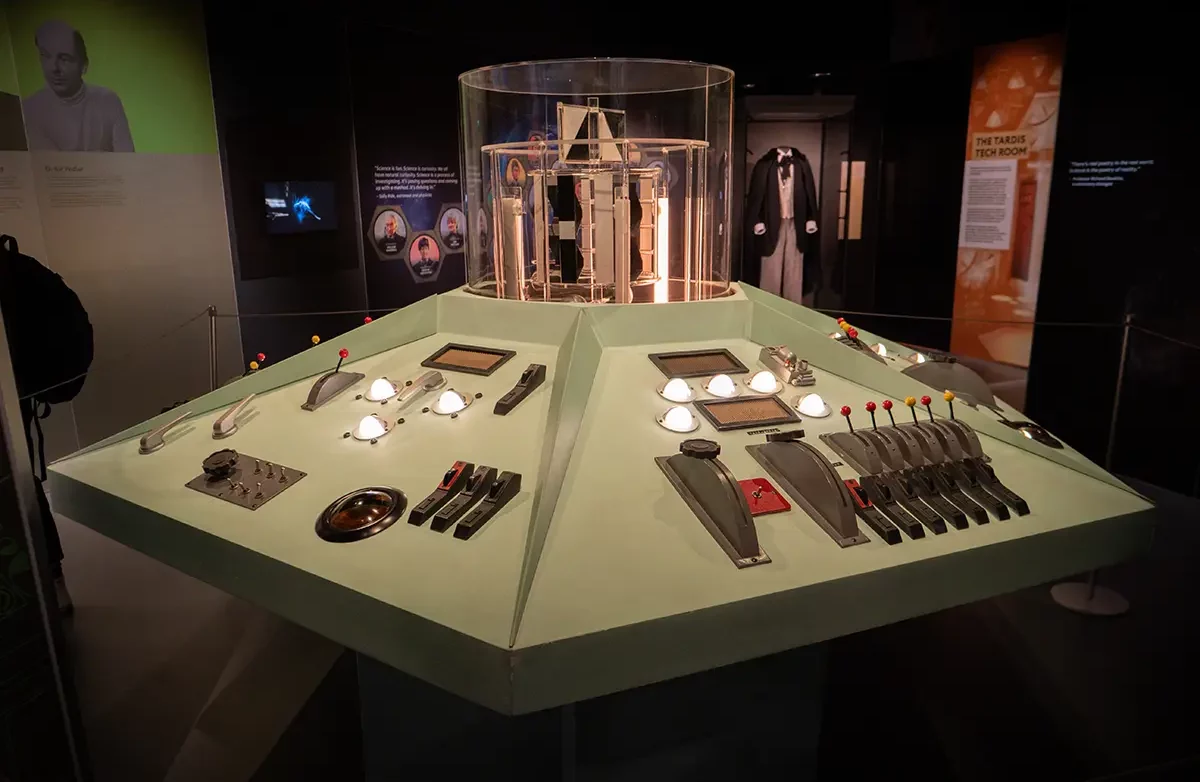
The Doctor also runs some questionable experiments with the TARDIS, which we can be sure that any technical documentation would have advised them against. One egregious example is John Pertwee’s Doctor removing the central console and hooking it up to a nuclear reactor in ‘Inferno’, in an effort to repower the dematerialisation circuits. Unfortunately, his botched experiment instead causes him to ‘travel sideways’ into an alternate dimension, where he becomes captured by a fascist version of UNIT. Funnily enough, one of the plot points of this episode is that many characters ignore procedures, technical documentation, and the warnings of a drilling expert, which led to the apocalyptic events of ‘Inferno’. The Doctor only manages to save his original dimension once he returns, because he has seen the dire consequences of ignoring safety procedures and warnings in the previous one.
Fortunately, in some episodes, we do get to see that the TARDIS Flight Manual/Standard Flight Procedures are actually well-written and useful pieces of technical writing. Some examples include:
- In ‘The Horns of Nimron’, the Doctor narrowly avoids damaging the TARDIS while trying to make some modifications. However, at K-9’s insistence, he reads the manual and deactivates the circuitry in time.
- In the previously mentioned ‘Vengeance on Varos’, after Perry insists that the Doctor read the manual, they use the technical information (and several tables on TARDIS power grids) to restore power to the TARDIS and arrive at Varos.
- In the previously mentioned ‘Doctor Who and the Pirate Planet’, Romana uses the instructions to safely land the TARDIS after the Doctor’s own botched landing.
- In ‘Castrovalva’, after his 5th regeneration into Peter Davidson, the Doctor is out of action, forcing companions Tegan and Nyssa to consult the TARDIS Information System: a kind of TARDIS-specific information portal. They manage to successfully pilot the TARDIS, despite having no previous experience of travel in space or time.
So what lessons can we learn from the TARDIS Flight Manual/Standard Flight Procedures? Despite having over 500 years of experience in flying the TARDIS, the Doctor could definitely learn from reading the manual. In fact, characters with much less experience in piloting spacecraft can easily do so by reading the supporting manual or information portal. It shows that even experts can learn something new by reading the documentation, and that by creating good-quality documentation that is easily accessible to readers of all experience levels, they can use complex equipment safely and effectively.
Need technical documentation even Doctor Who would read?
Companions and UNIT
Plenty of other examples show characters in Doctor Who reading documentation and using it to their advantage, even if they have little experience with the equipment. A couple of examples include ‘42’, where new companion Martha finds a technical manual for a stasis pod, allowing her to freeze the Doctor and stave off his possession by the spirit of a vengeful sun, despite the technology being several centuries more advanced than anything she has used before. In ‘Full Circle’, Romana reads a flight manual for the stricken vessel ‘Starlight’, and, despite having no experience with this type of craft, manages to avert disaster and passes it onto another character to help them pilot the craft.

Another notable documentation user is the UNIT (United Nations Intelligence Taskforce) organisation. UNIT includes many regular characters, such as Brigadier Lethbridge-Stewart, Sargent Benton, and Lieutenant Harry Sullivan, who all feature in many episodes assisting the Doctor against numerous threats. UNIT has its own research and science divisions, which create custom equipment and machinery, for which it also creates documentation. One of the best examples is ‘The Claws of Axos’, where a UNIT team of scientists and technicians use lots of data, including technical reports and procedures, to correctly predict the course of a UFO. Another good example is ‘Terror of the Autons’, where the Doctor faces a returning threat from the Autons after a Nestene energy unit, featured in a previous episode, is stolen. Luckily, UNIT personnel have thoroughly documented the Nestene energy unit and how the Autons use it, so characters in UNIT, like regular viewers, already know the threat it poses and are able to take action to counter it.
So what lessons can we learn from these examples? It shows that good technical documentation can help readers overcome dangerous or unexpected circumstances, as long as it is easily accessible and easy to understand. Martha had no hands-on experience with 22nd-century medical equipment, but was able to save the Doctor thanks to well-written documentation. Romana reads documentation often to quickly understand complex equipment and use it wisely. UNIT constantly creates new equipment and deploys it in the field, responding to strange and unique threats thanks to good technical documentation, which helps them do this somewhat effectively.
More like ‘Doctor Who should read some documentation’
I hope you’ve enjoyed this look at some classic sci-fi and its treatment of technical documentation. Please spare a thought for my long-suffering partner, who had to spend a very long weekend watching many episodes of Doctor Who for research for this article. I hope you have taken on board that technical documentation can teach everyone something new, even if they have been piloting a TARDIS for over 500 years. It can also help you quickly bridge the gap between novice and expert. I also hope you’ve taken the lesson that good technical documentation can help people adapt to unexpected or high-pressure situations, whether that be operating new equipment or tracking down invading aliens made out of plastic.
If you’d like to discuss a technical writing, translation, or content operations project, or who your favourite doctor is, feel free to get in contact with us here. We’d be more than happy to hear from you.